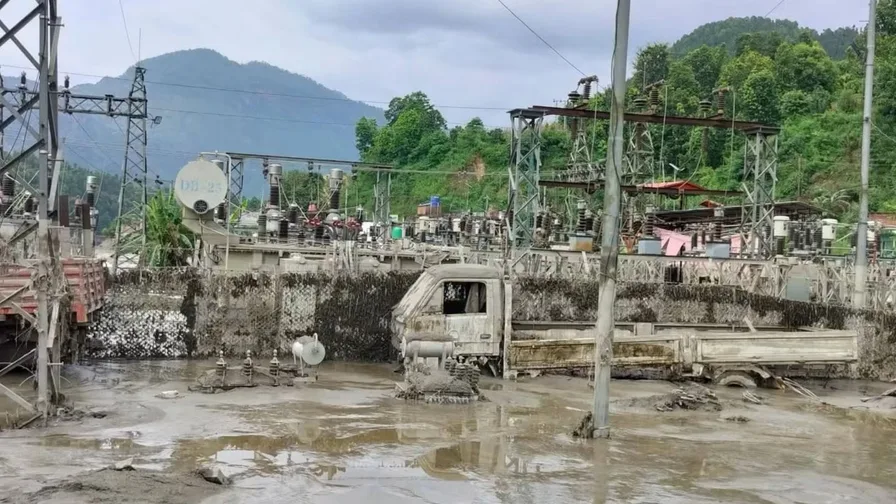
Hydro Projects Damaged 1 min readUninsured Hydro Projects Damaged by Floods Cost Nepal Electricity Authority Rs 25 BillionInsurance sector experts, however, have strongly criticized this approach, calling the failure to transfer risk a critical administrative oversight. Representatives from the Non-Life Insurers' Association pointed out that natural disasters do not provide advance warnings, and relying on past safety records to bypass insurance on vital national infrastructure creates unnecessary systemic vulnerability. Analysts warn that absorbing a Rs 25 billion deficit directly could ultimately force the utility to offset losses through future electricity tariff increases for consumers.Dipesh Ghimire·11 Sep, 2026
Upper Tamakoshi1 min readUnauthorized Expenditure of Rs 6 Billion in Upper Tamakoshi; Former NEA MD Ghising and Top Officials ImplicatedSimilar financial opacity has been observed in the 21 MW Rolwaling Khola Hydropower Project. While the standard construction cost for such projects generally ranges from Rs 200 million to Rs 250 million per megawatt, the cost for Rolwaling has unnaturally escalated to between Rs 550 million and Rs 600 million per megawatt. This abnormal cost inflation is expected to severely undermine the project's financial returns, directly victimizing hundreds of thousands of retail investors who purchased shares at premium prices in the secondary market. These actions have raised serious questions regarding the corporate governance of the project.Dipesh Ghimire·11 Sep, 2026
Money Laundering1 min readNepal’s Money Laundering Risk Remains ‘Medium-High’ Amid Weak ImplementationDue to the lack of result-oriented actions in controlling money laundering, the Financial Action Task Force (FATF) has kept Nepal under 'increased monitoring' since February 2025. To expedite the recovery of illicit wealth, the assessment suggests introducing non-conviction-based civil confiscation, which would allow authorities to seize assets without waiting for lengthy final court verdicts. Moving forward, the report emphasizes that Nepal must prioritize the strict enforcement of existing laws by aggressively adopting a 'follow the money' approach, rather than merely creating new legislation.Dipesh Ghimire·10 Sep, 2026
Top1 min readEconomic Blow of Bhote Koshi Floods: Tourism and Power Exports Hit Hard, Foreign Reserves Face PressureThe economic fallout of this disaster extends far beyond immediate reconstruction costs, posing a deeper threat to the nation's overall service exports and external economy. Experts emphasize that the government and the Nepal Tourism Board must urgently mobilize diplomatic missions to broadcast clear, accurate information to the global market regarding safe travel zones. Furthermore, stakeholders stress that moving forward, Nepal has no alternative but to adopt 'climate-resilient' infrastructure designs capable of withstanding the escalating risks of natural disasters.Dipesh Ghimire·10 Sep, 2026
meta1 min readMeta Launches 'Muse', a Personal AI Agent for Daily Tasks and Long-Term GoalsPositioned as the next-generation evolution of AI beyond basic chatbots, Muse is part of CEO Mark Zuckerberg’s long-term vision for personalized AI superintelligence. Zuckerberg has previously envisioned a future where every individual has an ultra-capable AI agent working 24/7 across areas like health, career, and personal finance. To address potential security and privacy risks associated with an agent capable of performing real digital tasks, Meta operates Muse within a secure virtual machine to safeguard user data.Dipesh Ghimire·9 Sep, 2026
Bhote Koshi Flood 2 min readGovernment to Prepare a Joint Report by Combining RDNA and World Bank Studies on Bhote Koshi Flood DamagesOnce the final details of the disaster damages are ready, the government will base its plans for immediate relief, rehabilitation, and reconstruction on them. This report will also serve as the foundation for determining the scale of investment required for reconstruction and for mobilizing resources. After finalizing the exact state of damage and required funds, the government intends to coordinate with development partners and friendly nations for assistance. While initial estimates showed severe economic damage, exact sectoral impacts and reconstruction costs will only become clear following this joint report.Dipesh Ghimire·9 Sep, 2026
IPO1 min read20 New Companies Gear Up for IPOs; Proposals Tabled in General MeetingsOnce these proposals are formally approved by their respective general meetings, the companies will initiate the necessary regulatory procedures with the Securities Board of Nepal (SEBON) and other relevant authorities to secure IPO approval. The growing entry of "real sector" companies—such as hospitals, hotels, and manufacturing firms—into a stock market traditionally dominated by financial institutions and hydropower is expected to boost market dynamism and provide the general public with wider and more diversified investment alternatives.Dipesh Ghimire·9 Sep, 2026
Excess Liquidity in the Bankin1 min readExcess Liquidity in the Banking Sector: Government Raises Domestic Debt at Cheaper Interest RatesThe government aims to raise a total of Rs 410 billion in domestic debt this fiscal year, including an issuance of Rs 10 billion through 'Development Bond-2088' on Bhadra 24. While the government increasingly relies on domestic borrowing to bridge the budget deficit, the country's total public debt has already reached Rs 2.97 trillion (45.10% of the GDP). Stakeholders warn that with sluggish revenue collection and public debt obligations nearing the Rs 3 trillion mark, managing principal and interest repayments will become a major challenge for the government in the coming days.Dipesh Ghimire·9 Sep, 2026
Sagar Dhakal1 min readClosing the Gap Between Policy and Practice Crucial for Market Momentum: SBAN President DhakalDhakal further noted that creating a conducive environment to channel investments made by Non-Resident Nepalis (NRNs) and Nepalis abroad back into the domestic market would significantly boost foreign currency reserves and state revenue. Stressing the need to expand institutional and foreign investor participation to enhance market transparency, competitiveness, and reliability, he urged all stakeholders to collaborate in materializing the positive reform signals emerging under the new leadership of the Securities Board of Nepal (SEBON).Dipesh Ghimire·7 Sep, 2026
Ramendra Rayamajhi1 min readStronger Surveillance and New Instruments Crucial for Market Stability: MBAN President RayamajhiRayamajhi further stressed that outdated and traditional laws can no longer address the dynamic needs of the modern capital market, calling for immediate structural and policy amendments. Additionally, he emphasized the urgency of adopting progressive policies and technology-driven practices to attract foreign investment and promote Environmental, Social, and Governance (ESG) based investments.Dipesh Ghimire·7 Sep, 2026