Biraj Bhakta Shrestha
Rivers as Heritage, Not Just Resource: Reading the Shift Behind Nepal's New Water Law
Taken together, the meeting represents an ambitious attempt to do three difficult things at once: reconceive rivers as heritage, resolve the federal tangle over who governs water, and modernise the country's energy base — all within a single legislative push. The vision is coherent and, in places, genuinely forward-looking. The harder question, as ever in Nepal's federal experiment, is implementation. Whether this becomes a landmark reform or another well-intentioned framework will depend on whether the promised division of powers holds up once real money, real projects and real provincial ambitions are placed on the table.
Dipesh Ghimire
4 min read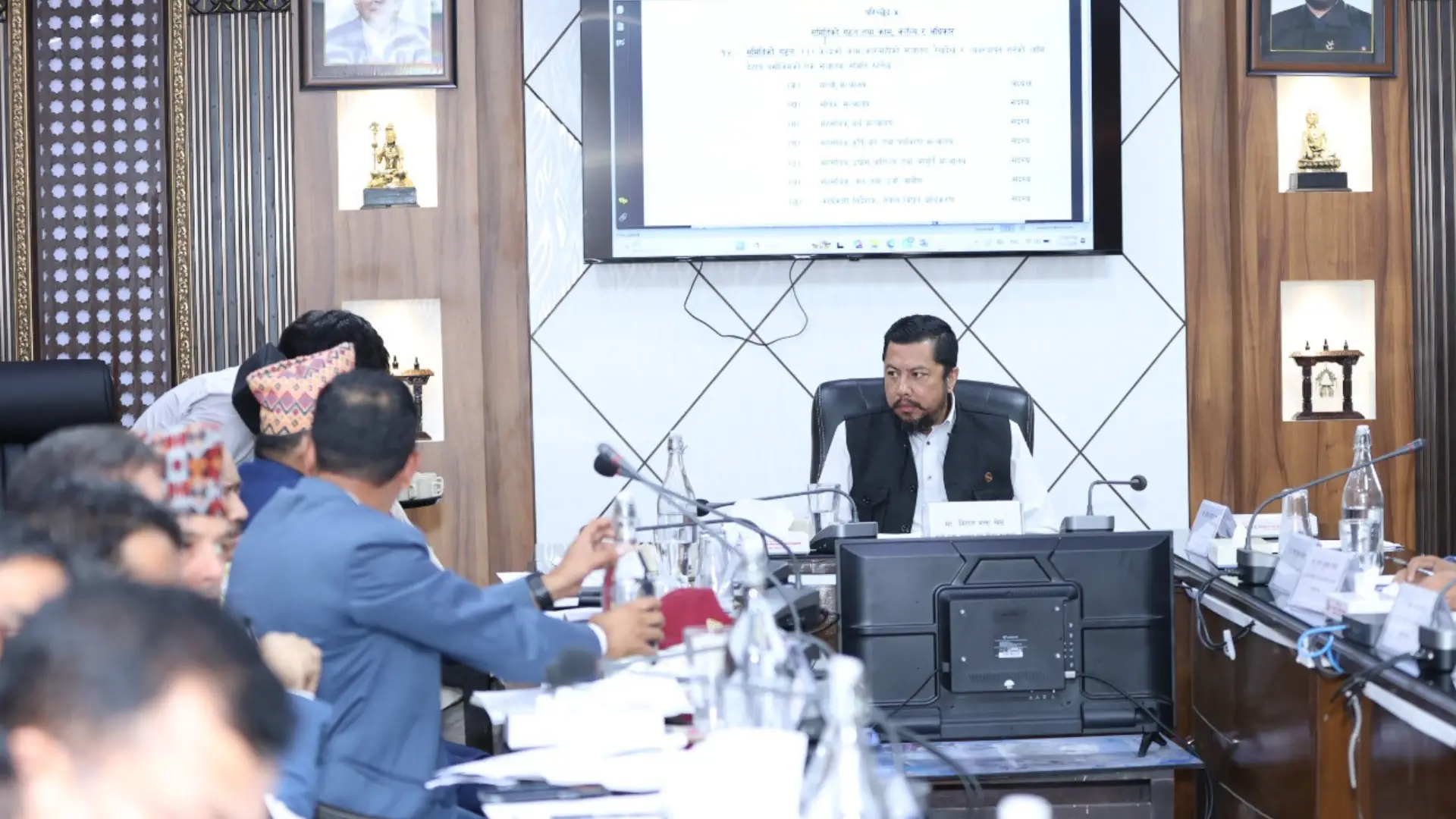
Kathmandu — When Energy Minister Biraj Bhakta Shrestha told a gathering of all seven provinces' energy ministers that coordination among the three tiers of government is "indispensable," the line could easily have been dismissed as the usual language of federal cooperation. But the substance of what he laid out on Tuesday points to something more consequential: an attempt to redraw how Nepal legally understands, divides and governs its water — and to do so before the current session of parliament closes.
The most striking conceptual shift lies in how the government now proposes to define a river. Shrestha framed rivers not merely as water resources but as the foundation of civilisation, culture, biodiversity and human existence. This is not decorative language. In legal and policy terms, how you define a resource determines how you are allowed to treat it. A river seen only as water is something to be dammed, diverted and monetised; a river seen as heritage carries obligations of conservation, cultural protection and environmental balance. By elevating rivers to the status of national heritage — and explicitly tying them to the traditions of indigenous communities — the ministry is signalling that future projects may face a higher bar than pure economic calculation.
Yet this elevated vision sits alongside a very practical, and politically delicate, problem: who actually controls the water. The heart of the meeting was the need for a legal framework to clearly divide rights, obligations and responsibilities among the federal, provincial and local governments. This is the unresolved tension at the centre of Nepal's federalism. The constitution grants all three tiers rights over natural resources, but in practice those overlapping claims have produced confusion, duplication and disputes — especially over lucrative hydropower. The proposed water resources bill is, at its core, an effort to convert that constitutional ambiguity into a workable division of labour.
Shrestha's repeated emphasis on process rather than rhetoric is itself revealing. His insistence that the meeting produce "joint action plans, clear responsibilities, time-bound implementation and regular monitoring" reads as a tacit acknowledgement that past coordination efforts have too often ended in talk. The language of deadlines and monitoring suggests an awareness that the credibility of federal cooperation now depends on delivery, not declarations — a recognition that provinces have grown impatient with being consulted in principle but sidelined in practice.
The bill's design also reflects a careful balancing act between centralisation and devolution. On one hand, the framework is being drafted at the federal level and pushed toward parliament by the ministry; on the other, Shrestha stressed that once passed, provinces and local bodies could legislate within their own jurisdictions, and that their input would shape the law itself. This dual message — a federally-authored framework that then empowers lower tiers — is the practical compromise at the heart of cooperative federalism. Its success will hinge on whether provinces feel they are genuine co-authors or merely implementers of a Kathmandu-drafted text.
The inclusion of irrigation and agriculture broadens the stakes beyond hydropower headlines. By calling for year-round irrigation, easier access to seeds and fertiliser, and better marketing of produce — and by asking provinces to submit project proposals on time — Shrestha connected water governance directly to food security and rural livelihoods. The subtext is a familiar bottleneck: federal resources exist, but weak, late or poorly prepared proposals from below often stall their deployment. The minister is, in effect, telling provinces that the efficiency of the whole system depends partly on their own readiness.
Running in parallel is the renewable energy and energy efficiency bill, which Shrestha positioned as a legal foundation for green hydrogen, solar, wind and biomass. This signals a deliberate attempt to future-proof Nepal's energy policy beyond its traditional reliance on large hydropower. Pairing a water resources law with a renewables law suggests the ministry is thinking about diversification and clean-energy transition together, rather than treating them as separate agendas — an approach that aligns with global shifts but will require regulatory clarity to attract the investment such technologies demand.
The shared-priority list that emerged from the meeting — water quality, pollution control, flood management, erosion prevention and disaster risk reduction — rounds out the picture and hints at lessons learned from recent years. These are not glamorous, revenue-generating concerns; they are the protective, preventive functions of water governance that tend to be neglected until a disaster forces attention. Their prominence suggests that climate-driven flooding and environmental degradation are now shaping the policy conversation as much as generation capacity.
Taken together, the meeting represents an ambitious attempt to do three difficult things at once: reconceive rivers as heritage, resolve the federal tangle over who governs water, and modernise the country's energy base — all within a single legislative push. The vision is coherent and, in places, genuinely forward-looking. The harder question, as ever in Nepal's federal experiment, is implementation. Whether this becomes a landmark reform or another well-intentioned framework will depend on whether the promised division of powers holds up once real money, real projects and real provincial ambitions are placed on the table.
Advertisement
Written by
Dipesh Ghimire