Top
What is Elliott Wave Theory? A Complete Guide for Traders and Investors
What is Elliott Wave Theory? A Complete Guide for Traders and Investors Elliott Wave Theory is a widely used technical analysis concept that explains how financial markets move in repetitive patterns driven by investor psychology. Developed by Ralph Nelson Elliott in the 1930s, the theory suggests that market prices do not move randomly but follow structured wave patterns influenced by crowd behavior—mainly fear and greed.
Dipesh Ghimire
2 min read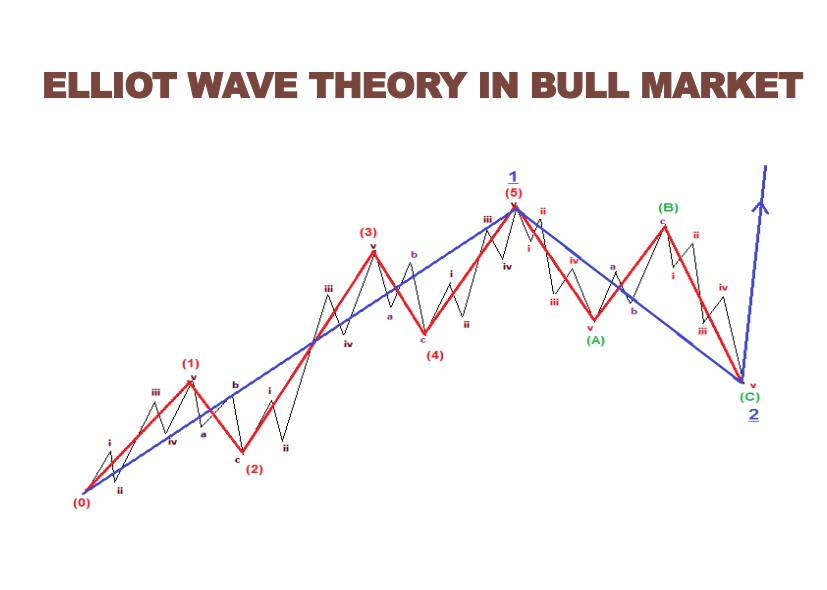
Elliott Wave Theory is a widely used technical analysis concept that explains how financial markets move in repetitive patterns driven by investor psychology. Developed by Ralph Nelson Elliott in the 1930s, the theory suggests that market prices do not move randomly but follow structured wave patterns influenced by crowd behavior—mainly fear and greed.
At its core, Elliott Wave Theory states that markets move in a cycle of five impulsive waves followed by three corrective waves. The five-wave structure (1, 2, 3, 4, 5) represents the main trend, while the three-wave correction (A, B, C) represents a temporary reversal against that trend. This pattern repeats across all timeframes, making it a fractal-based theory applicable to both short-term trading and long-term investing.
The impulse waves (1, 3, and 5) move in the direction of the main trend. Wave 1 starts the trend, often quietly. Wave 2 is a correction that does not break the starting point. Wave 3 is usually the strongest and longest wave, driven by strong market participation. Wave 4 is another correction, often shallow, and wave 5 marks the final push of the trend, often accompanied by high optimism or pessimism.
After the impulse phase, the market enters the corrective phase, consisting of waves A, B, and C. Wave A begins the reversal, wave B gives a false signal that the trend might continue, and wave C completes the correction, often with strong momentum. This phase helps the market stabilize before starting a new cycle.
One of the key advantages of Elliott Wave Theory is its ability to help traders identify market cycles, predict potential reversals, and find high-probability entry points. For example, many traders look for buying opportunities near the end of wave C or during the early stages of wave 3, as these phases often offer strong risk-to-reward setups.
However, Elliott Wave Theory is not a guaranteed prediction tool. It requires experience, practice, and confirmation using other indicators such as RSI, MACD, volume analysis, and price action. Since wave counting can sometimes be subjective, traders must use proper risk management and avoid relying solely on one method.
In modern markets like the NEPSE Index, where sentiment-driven movements are common, Elliott Wave Theory can provide valuable insights into trend direction and market structure. By combining this theory with other technical tools, traders can improve their decision-making and enhance overall trading performance.
In conclusion, Elliott Wave Theory is a powerful framework that reveals how markets move in predictable cycles based on human psychology. Understanding these wave patterns can give traders a strategic edge in navigating both bullish and bearish market conditions.
Advertisement
Written by
Dipesh Ghimire