Top
Global Money Week 2026 Begins, Emphasis on Early Financial Literacy and Inclusion
Global Money Week 2026 Begins, Emphasis on Early Financial Literacy and Inclusion Kathmandu — The fourteenth edition of Global Money Week has commenced in Nepal with a renewed focus on strengthening financial literacy among young people under the theme “Smart Money Talks.” The week-long campaign, observed globally every March, aims to equip students with essential knowledge on earning, saving, and managing money—skills increasingly seen as critical in today’s evolving economic environment.
Dipesh Ghimire
3 min read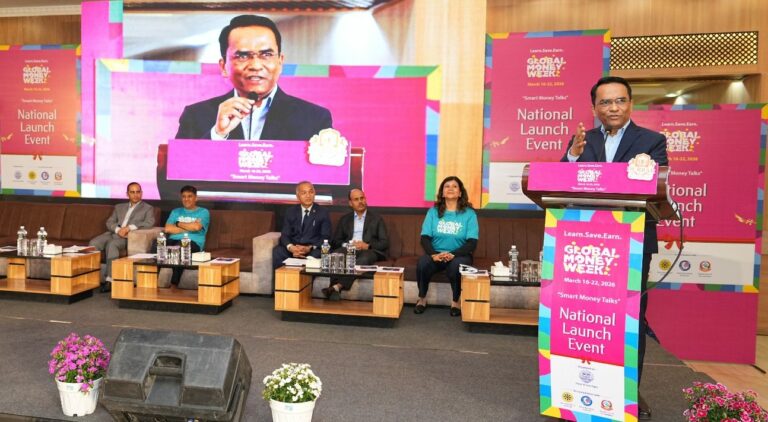
Kathmandu — The fourteenth edition of Global Money Week has commenced in Nepal with a renewed focus on strengthening financial literacy among young people under the theme “Smart Money Talks.” The week-long campaign, observed globally every March, aims to equip students with essential knowledge on earning, saving, and managing money—skills increasingly seen as critical in today’s evolving economic environment.
The national launch event, jointly organized by Nepal Rastra Bank in collaboration with the Insurance Authority, Securities Board, and the Department of Cooperatives, brought together around 500 students from Grades 8 to 10 in Kathmandu. The participation of students at this formative stage reflects a growing recognition among policymakers that financial awareness must begin early, particularly in a country where formal financial education is still limited in school curricula.
Speaking at the inauguration, National Planning Commission Vice-Chairman Bishwanath Poudel underscored the importance of embedding financial discipline at the household level. He highlighted that financial behavior—how individuals earn, spend, and save—often begins within families, and early exposure to these concepts can shape long-term economic decision-making. His remarks signal a broader policy shift toward integrating financial literacy not just as an academic subject but as a life skill rooted in everyday practice.
Officials from Nepal Rastra Bank further emphasized the institutional commitment to improving financial awareness. Executive Director Dayaram Sharma Poudel noted that programs like Global Money Week are designed to bridge the knowledge gap among students and prepare them for responsible financial participation. He also pointed out that Nepal’s financial inclusion index has reached 0.53 in the fiscal year 2024/25, indicating moderate progress but also highlighting the need for continued efforts to expand access and usage of financial services.
The second session of the program featured a panel discussion involving senior representatives from key financial regulatory bodies, including the central bank, securities board, insurance authority, and cooperative sector. The interaction between policymakers and students provided a platform for direct engagement, allowing participants to gain practical insights into how financial systems operate and how individuals can navigate them effectively. Such dialogue-based learning is increasingly seen as more impactful than traditional classroom instruction.
The campaign, which will run until Chaitra 8, includes a wide range of activities across the country. Banks, financial institutions, payment service providers, and remittance companies are actively participating in outreach initiatives. These include interactive sessions, competitions, media campaigns, and exposure visits to financial institutions. The multi-stakeholder involvement reflects an understanding that improving financial literacy requires coordinated efforts across both public and private sectors.
Globally, Global Money Week has grown into a significant platform for financial education since its inception in 2012 under the coordination of the OECD. Nepal has been participating since 2013, aligning its national efforts with international best practices. To date, the campaign has reached over 70 million children across 176 countries, illustrating its scale and relevance in promoting financial awareness worldwide.
From a broader perspective, the continued emphasis on financial literacy comes at a time when Nepal’s economy is undergoing structural changes, including increased digitization of financial services and growing participation in capital markets. As access to financial products expands, the risk of misuse or uninformed decision-making also rises. Initiatives like Global Money Week aim to address this gap by fostering informed and responsible financial behavior from a young age.
While the progress in financial inclusion is encouraging, experts suggest that sustained impact will depend on integrating such programs into the formal education system and ensuring continuity beyond awareness campaigns. The success of Global Money Week, therefore, lies not only in participation numbers but in its ability to translate knowledge into long-term behavioral change among future generations.
Advertisement
Written by
Dipesh Ghimire