Export
Nepal’s Export Sees Remarkable Growth in FY 2024/25 with Soyabean Oil
Nepal’s export composition over the past three fiscal years. Most notably, Soyabean Oil has emerged as a dominant export item, surging from under Rs. 1 billion in 2023/24 to over Rs. 93.5 billion in 2024/25, reshaping the export landscape. Other commodities such as Polyester Yarn & Thread, Jute Goods, Tea, Shoes and Sandals, and Rosin have shown consistent growth, reflecting diversification in industrial and semi-processed goods. Conversely, traditional export leaders like Palm Oil, Readymade Garments, and Zinc Sheets have seen sharp declines, indicating changing global demand or policy impacts. Overall, the export pattern highlights Nepal’s shifting strengths toward agro-industrial and synthetic products, while still maintaining a foothold in heritage goods like Woolen Carpets and Pashmina.
Sandeep Chaudhary
2 min read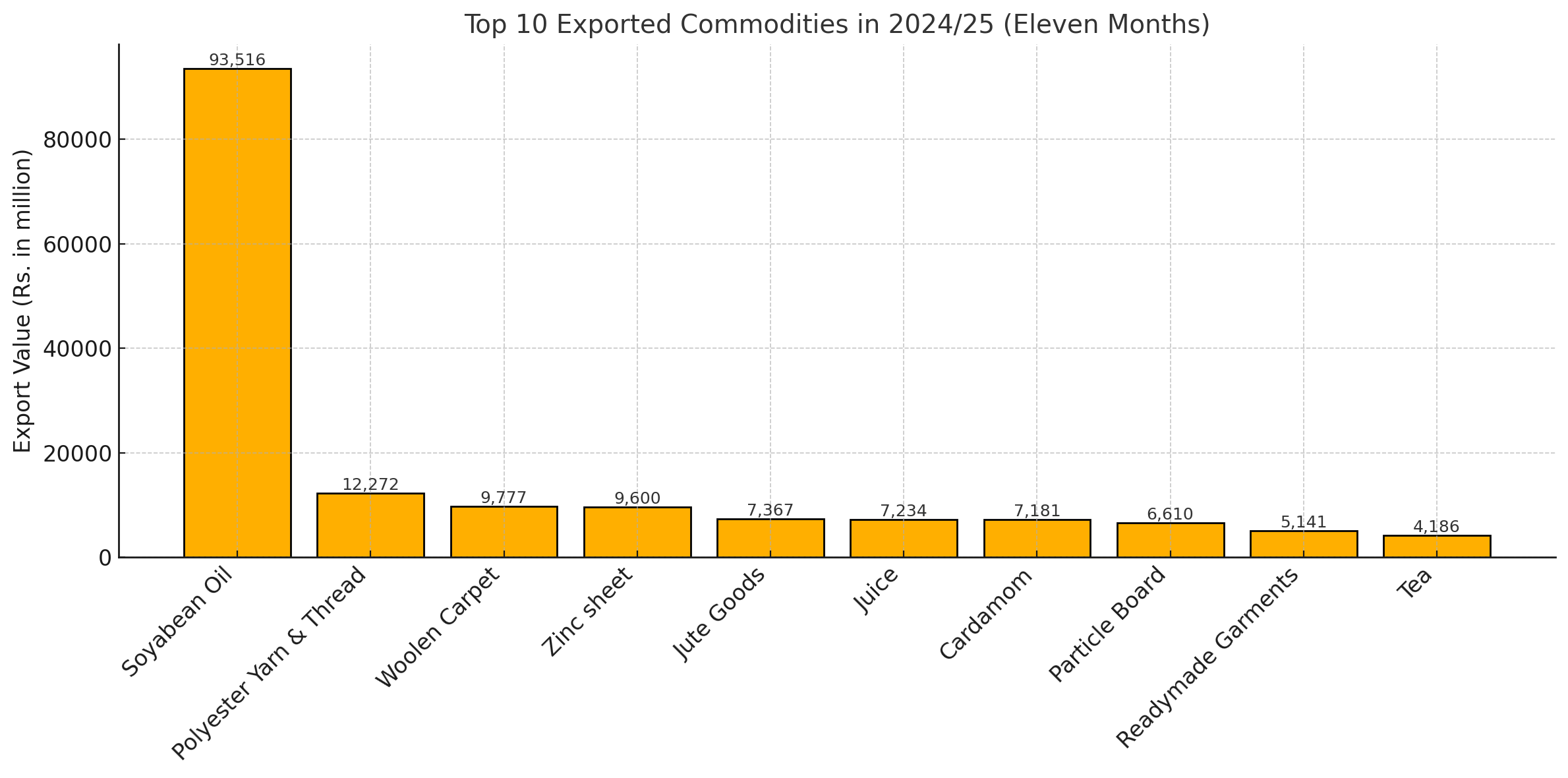
Kathmandu, July 9 — Nepal's export sector has seen a robust resurgence in the fiscal year 2024/25, with total exports reaching an estimated Rs. 247.57 billion in the first eleven months—an impressive 77.8% increase compared to the same period in the previous fiscal year, according to the latest trade statistics.
Soyabean Oil Drives Export Boom
The standout performer was Soyabean Oil, registering a dramatic surge to Rs. 93.52 billion, accounting for 37.8% of total exports. This is a staggering rise from just Rs. 874.88 million in the previous fiscal year's same period. Such exponential growth signals a major shift in Nepal’s export composition, likely driven by high external demand and favorable trade arrangements, particularly with India.
Other Top Performing Commodities
Polyester Yarn and Thread followed with Rs. 12.27 billion in exports, marking a 22% growth, while Woolen Carpetremained stable at Rs. 9.77 billion, contributing 3.9% of total exports.
Zinc Sheets saw a drop of 10.2%, falling to Rs. 9.6 billion, despite a strong performance in 2023/24. On the other hand, Jute Goods bounced back with a 19% increase, totaling Rs. 7.36 billion.
Notably, Tea exports surged by 33%, while Oil Cakes, Textiles, and Shoes and Sandals also reported double-digit growth, highlighting broader diversification in Nepal’s export basket.
Sharp Declines in Palm Oil and Readymade Garments
In contrast, Palm Oil exports plummeted by 68.4%, contributing only 0.8% to total exports. This sharp decline could be attributed to changes in import policies of trading partners or shifting regional competition.
Likewise, Readymade Garments and Juice saw contractions of 11.4% and 8.6%, respectively, while Cardamom and Herbs, two traditional Nepali exports, experienced moderate declines.
Top 20 Commodities Dominate Export Share
The top 20 export commodities cumulatively reached Rs. 183.43 billion, accounting for 74.1% of the total exports—more than doubling from the previous year’s Rs. 90.66 billion in eleven months.
Strong Rise in 'Others' Category
The “Others” category—covering smaller or less-consistent export items—reached Rs. 64.14 billion, up by 32%, suggesting growing momentum in non-traditional exports.
Electricity and Aviation Fuel: Mixed Performance
Among additional export sectors, Electricity exports dropped to Rs. 11.26 billion from Rs. 14.05 billion a year ago, while Aviation Fuel exports stood at Rs. 13.70 billion, up from Rs. 12.27 billion, showing moderate improvement.
The significant rise in total exports, particularly led by soyabean oil and diversified industrial products, reflects a positive trajectory for Nepal’s trade sector. However, dependency on a few key commodities and market concentration remain vulnerabilities. Enhancing value chains and market diversification will be key for sustaining long-term growth.
Advertisement
Written by
Sandeep Chaudhary