Export to China
Nepal's Export to China Grows by 3%, Driven by Woolen Carpets and Agarbatti, Despite Noodle Collapse
In the first eleven months of FY 2024/25, Nepal's exports to China showed a mixed performance across major commodities. Woolen carpets emerged as the top export item, witnessing a sharp increase from Rs. 383 million to Rs. 706.3 million — an 84.4% rise. Pashmina and agarbatti also performed well, with increases of 44.8% and 21% respectively. In contrast, noodle exports suffered a drastic fall of 85%, dropping from Rs. 149.8 million to Rs. 22.5 million. Similarly, handicrafts (metal and wooden) and rudrakshya saw declines of 21.4% and 26.3%. The export of readymade garments and leather goods also dropped. Overall, while certain traditional and artisanal goods gained traction in the Chinese market, others, particularly processed foods and crafts, struggled to maintain their momentum.
Sandeep Chaudhary
2 min read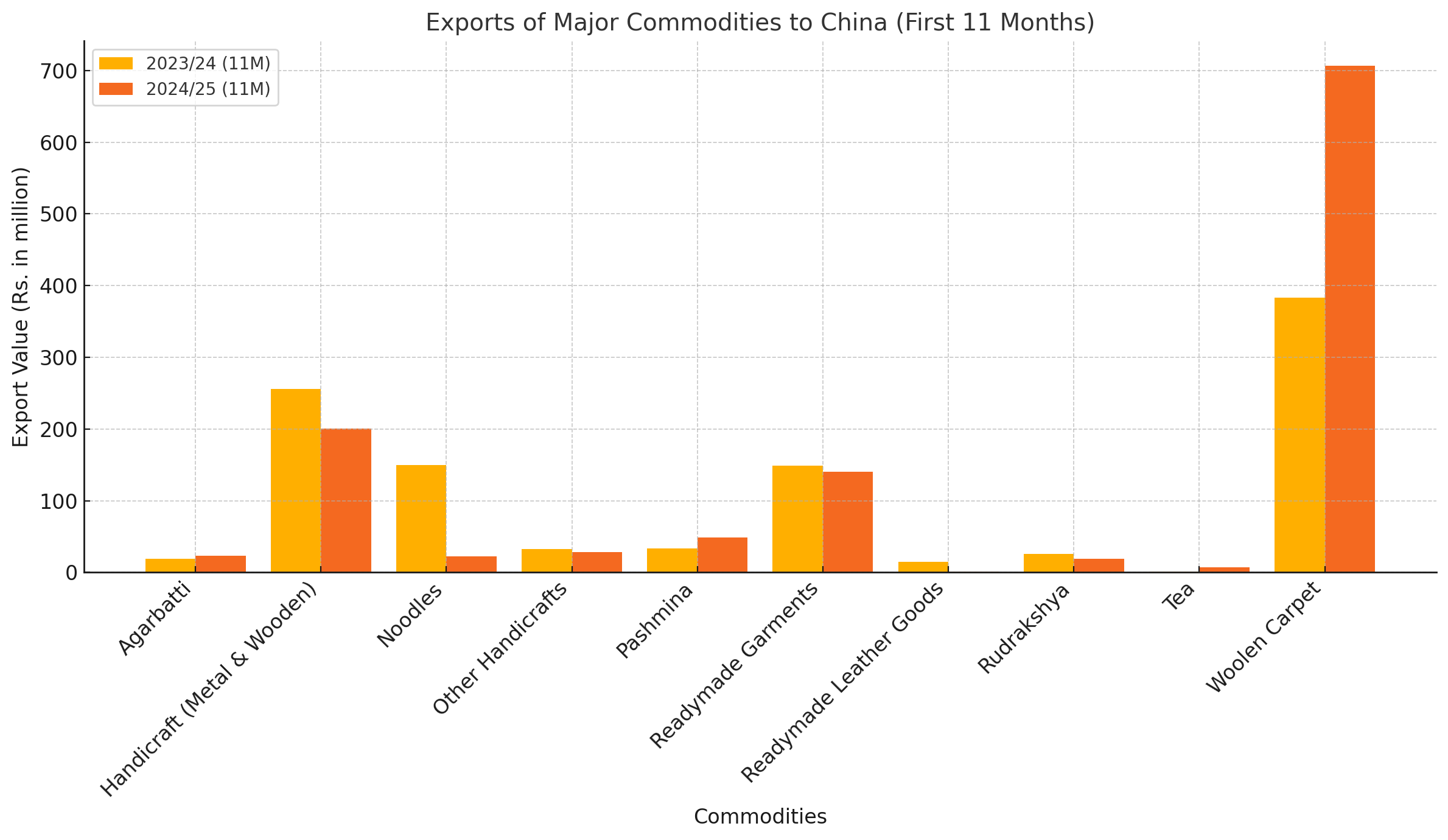
Kathmandu, July 9 — Nepal's exports to China have recorded a modest growth of 3% in the first eleven months of the fiscal year 2024/25, reaching Rs. 2.48 billion, up from Rs. 2.41 billion in the same period last year. The surge was primarily supported by a significant rise in the export of woolen carpets, pashmina, and agarbatti, although a sharp decline in noodle exports pulled down the overall momentum.
Major Commodities See 11.2% Growth
Exports under the "Major Commodities" category rose by 11.2%, totaling Rs. 1.19 billion. Among them, woolen carpets became the top export item, skyrocketing to Rs. 706.3 million, marking a massive 84.4% increase from the previous year's eleven-month figure. Similarly, pashmina exports surged by 44.8%, reaching Rs. 48.8 million, and agarbatti exports rose by 21% to Rs. 23 million.
Handicrafts Decline, Noodles Plunge
Despite the positive trend in some sectors, handicraft (metal and wooden) exports dropped by 21.4% to Rs. 200.9 million, a reversal after a strong previous year. The most concerning figure was seen in noodle exports, which collapsed by 85%, falling to just Rs. 22.5 million, compared to Rs. 149.8 million last year.
Mixed Performance in Other Products
Exports of readymade garments continued to slide, falling by 5.9% to Rs. 140.5 million. Rudrakshya also declined by 26.3%, and readymade leather goods dropped drastically by 89.5%, signaling limited demand or supply-side issues. On a positive note, tea exports grew significantly from Rs. 0.9 million to Rs. 7 million, indicating renewed traction in the Chinese market.
"Others" Category Contracts
Contrary to the growth in major commodities, the “Others” category witnessed a 3.7% decline, dropping to Rs. 1.28 billion from Rs. 1.33 billion. This contraction trimmed the overall export growth, which could have been stronger without this drop.
Annual Outlook and Trade Diversification Needed
Despite a relatively subdued annual growth rate of 3%, the diversification of export products and the success of items like woolen carpets and pashmina reflect promising trends. However, the sharp fall in key categories like noodles, handicrafts, and leather goods highlights the urgent need for strategic product and market development to sustain trade momentum with China.
Advertisement
Written by
Sandeep Chaudhary