Top
NEPSE at a Critical Juncture: Sharp Fall Signals Bearish Pressure, Yet Support Zone Offers Hope
NEPSE at a Critical Juncture: Sharp Fall Signals Bearish Pressure, Yet Support Zone Offers Hope Kathmandu — Nepal’s stock market entered a decisive phase following a sharp decline in the previous trading session, with technical indicators pointing toward rising bearish pressure even as the index attempts to stabilize near a key support zone. The sudden drop has raised concerns among investors, but underlying signals suggest the market may still be in a transitional phase rather than a confirmed downtrend.
Dipesh Ghimire
3 min read
Kathmandu — Nepal’s stock market entered a decisive phase following a sharp decline in the previous trading session, with technical indicators pointing toward rising bearish pressure even as the index attempts to stabilize near a key support zone. The sudden drop has raised concerns among investors, but underlying signals suggest the market may still be in a transitional phase rather than a confirmed downtrend.
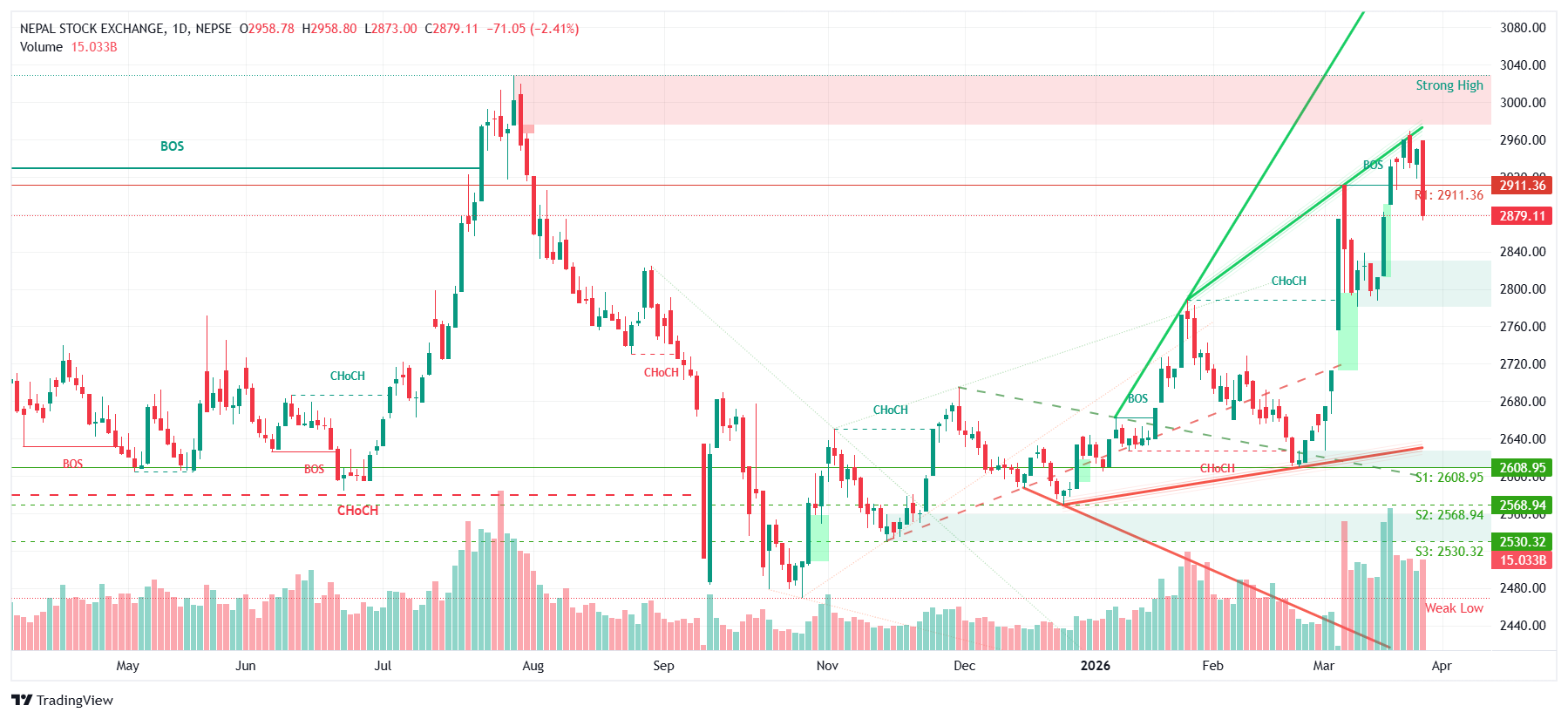
The NEPSE index formed a strong bearish candlestick pattern, invalidating the earlier bullish sentiment seen during the previous session. What initially appeared to be a potential recovery signal was quickly negated as the market closed below the prior day’s low, forming a classic bearish engulfing pattern. This development is widely interpreted by technical analysts as a short-term reversal signal, indicating weakening upward momentum.
Adding to the concern, the Relative Strength Index (RSI) is showing signs of bearish divergence, where price levels had been rising while momentum failed to keep pace. This typically suggests that the underlying strength of the rally is fading, increasing the likelihood of further downside pressure in the near term.
Despite these negative signals, the market has not entirely lost its structural strength. The recent decline has effectively filled the gap created during the earlier gap-up opening, and the index managed to close slightly above that zone. This behavior often indicates that the market is testing a strong support level rather than breaking down immediately.
Moreover, the index has retested a previously broken trendline that had acted as resistance. In technical terms, such retests are crucial—if the level holds, it may validate the trendline as a new support and pave the way for a rebound. This keeps the possibility of a “healthy pullback” intact, rather than a full-fledged bearish trend reversal.
However, the structure of intraday movement paints a cautious picture. The formation of lower highs and lower lows throughout the session reflects a clear dominance of sellers. This pattern typically signals that the market is under distribution, where selling pressure outweighs buying interest.
Volume analysis further reinforces this concern. The decline was accompanied by higher trading volume during red candlesticks, while green movements were supported by relatively weaker volume. This imbalance suggests that sellers are more aggressive and confident, a sign that the market sentiment is currently tilted toward the downside.
Sector-wise activity also reveals an uneven market structure. Hydropower stocks continued to dominate trading, accounting for a significant portion of total turnover, while other sectors showed limited participation. Such concentration often indicates that the broader market lacks uniform strength, making the rally less sustainable in the short term.
Interestingly, data from major brokers indicates that institutional or large investors may still be accumulating selectively. A majority of top brokers were net buyers, suggesting that while retail participants may be exiting positions, larger players could be positioning themselves for medium- to long-term opportunities.
Looking ahead, the market’s direction will largely depend on how it reacts around the current support zone. If the index breaks below the recent low with strong volume, it could confirm a deeper correction phase. On the other hand, a recovery above the midpoint of the recent bearish candle would signal that selling pressure is weakening, potentially leading to a short-term rebound.
In essence, the NEPSE is currently navigating a delicate balance between bearish momentum and structural support. The coming sessions will be crucial in determining whether the recent fall marks the beginning of a broader downturn or merely a temporary correction within an ongoing upward trend.
Advertisement
Written by
Dipesh Ghimire