Top
New Government Takes Office Under Balen Shah Amid Rising Economic Risks and High Public Expectations
New Government Takes Office Under Balen Shah Amid Rising Economic Risks and High Public Expectations The swearing-in of Balen Shah as Nepal’s new Prime Minister marks the beginning of a politically decisive phase, but one that is equally loaded with economic uncertainty. Administered by President Ram Chandra Poudel at Shital Niwas, the ceremony symbolized not just a transfer of power but a shift toward a new political narrative driven by fresh leadership. The formation of a full cabinet alongside the Prime Minister indicates an immediate push toward governance, yet the underlying economic landscape suggests that the real test lies ahead.
Dipesh Ghimire
3 min read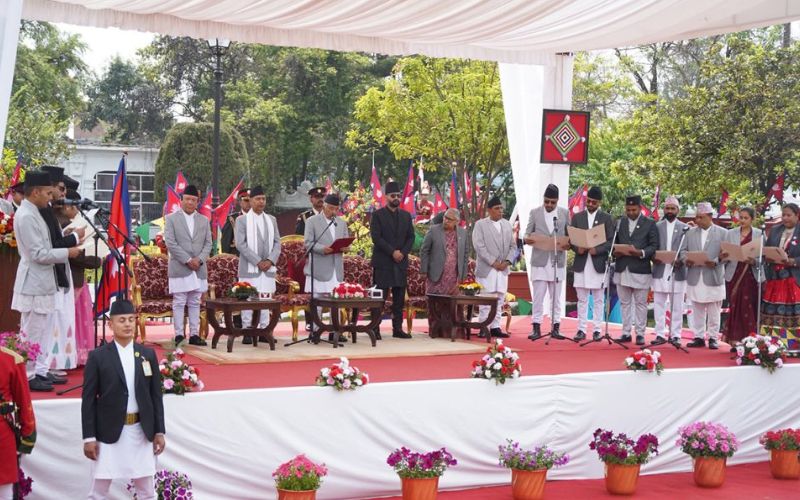
The swearing-in of Balen Shah as Nepal’s new Prime Minister marks the beginning of a politically decisive phase, but one that is equally loaded with economic uncertainty. Administered by President Ram Chandra Poudel at Shital Niwas, the ceremony symbolized not just a transfer of power but a shift toward a new political narrative driven by fresh leadership. The formation of a full cabinet alongside the Prime Minister indicates an immediate push toward governance, yet the underlying economic landscape suggests that the real test lies ahead.
The appointment of Dr. Swarnim Wagle as Finance Minister places a technocratic figure at the center of Nepal’s economic policy. However, his entry into office coincides with a critical fiscal timeline, as the national budget deadline approaches rapidly. Beyond procedural urgency, deeper structural concerns—such as weak revenue performance, stagnant investment, and limited industrial expansion—pose immediate constraints. The expectation that a new leadership team can quickly reverse these trends appears optimistic, especially given the complexity of Nepal’s economic framework.
Global developments, particularly escalating tensions in the Middle East, have begun casting a shadow over Nepal’s economic outlook. Rising petroleum prices, driven by disruptions in global supply chains, are already feeding into inflationary pressures. For a country heavily dependent on imports, especially fuel, such external shocks quickly translate into higher costs of transportation, production, and daily consumption. This inflationary trend is not merely cyclical; it signals a broader vulnerability in Nepal’s economic structure, where external factors disproportionately influence domestic stability.
Equally concerning is the potential impact on remittance inflows, a cornerstone of Nepal’s economy. With nearly 1.7 million Nepali workers employed in Middle Eastern countries, prolonged geopolitical instability could threaten both employment and income streams. Remittance contributes a substantial share to Nepal’s GDP, and any disruption could create ripple effects across consumption, banking liquidity, and overall economic momentum. While recent data shows strong growth in remittance inflows, the sustainability of this trend is now uncertain under evolving global conditions.
Domestically, the contradiction between high liquidity in financial institutions and low investment activity highlights a deeper confidence gap in the market. Banks continue to hold excess funds, yet private sector borrowing and expansion remain subdued. This suggests that the issue is not merely financial availability but a lack of conducive investment climate—driven by policy uncertainty, regulatory inefficiencies, and limited industrial incentives. The new government’s ability to address these systemic barriers will be crucial in determining whether economic recovery gains traction.
The policy commitments outlined by Rastriya Swatantra Party further add to the complexity of governance. Promises such as returning cooperative victims’ savings within 100 days, restructuring financial oversight, and accelerating economic growth reflect an ambitious agenda. However, the scale of financial irregularities in the cooperative sector alone suggests that these commitments will require more than political will—they demand institutional capacity, fiscal resources, and coordinated execution. Without these, there is a risk that expectations may outpace delivery.
At the same time, the government’s broader economic vision—emphasizing innovation, entrepreneurship, and regulatory reform—indicates a shift toward long-term structural transformation. Plans to simplify legal frameworks, establish one-stop investment services, and strengthen financial supervision reflect an understanding of underlying economic bottlenecks. If implemented effectively, these measures could gradually improve Nepal’s business environment and attract both domestic and foreign investment.
In essence, the new administration begins its tenure at a critical intersection of opportunity and risk. Political stability provides a foundation for reform, but economic realities demand cautious and strategic policymaking. The coming months will not only test the government’s administrative capability but also its ability to balance immediate pressures with long-term vision. Whether this new leadership can convert public optimism into tangible outcomes remains the defining question for Nepal’s economic future.
Advertisement
Written by
Dipesh Ghimire