PM Balen
PM Balen's Proposal at the UN: Establish a 'Himalayan Climate Mechanism' Involving Nepal, India, and China
– Prime Minister strongly criticizes the global order where developed countries can deliver weapons on time but poor farmers cannot get fertilizers. – Bhote Koshi-Trishuli flood termed a 'Himalayan Tsunami'. Presenting himself as possibly the youngest head of government to address the General Assembly this year, Shah made it clear that the younger generation demands a politics of honesty and accountability. He stated that his government is committed to investing in long-term preparedness, robust infrastructure, and innovation rather than patchwork, reactionary responses. Concluding his address, he invoked Lord Pashupatinath and Buddha, emphasizing the need to simultaneously advance post-disaster 'relief, rehabilitation, and reconstruction' alongside the 'responsibility, compensation, and resilience' of developed nations.
Dipesh Ghimire
2 min read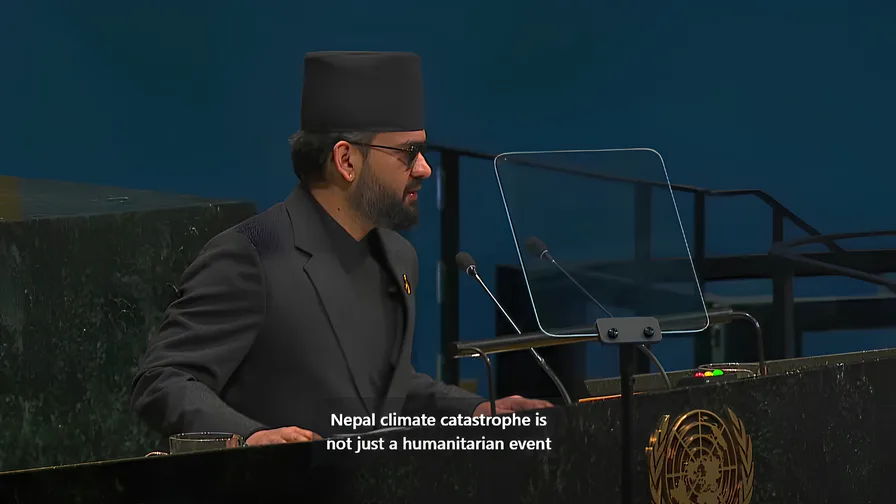
New York: Addressing the 81st General Assembly of the United Nations, Prime Minister Balen Shah has proposed the establishment of a 'Himalayan Climate Resilience Mechanism' led by Nepal, India, and China to combat the crisis brought about by climate change. Speaking boldly on climate justice and the crisis in the Himalayan region, he questioned the double standards of developed nations and fiercely criticized the global supply chain and justice system.
Terming the devastating floods in the Bhote Koshi and Trishuli rivers in Nepal about a month ago as a 'Himalayan Tsunami,' Prime Minister Shah interpreted the disaster as a severe warning of an impending global crisis. Presenting staggering statistics of over 1,400 confirmed deaths and more than 6,000 still missing due to the floods, he claimed the catastrophe is not merely a local tragedy but a worldwide consequence of climate change. Pointing out that around 10 percent of the Gross Domestic Product (GDP) is required for the reconstruction of physical infrastructure, he appealed for international solidarity and grant assistance akin to the aftermath of the 2015 earthquake.
The 'Himalayan Climate Mechanism' proposed by the Prime Minister specifically emphasizes trilateral cooperation between Nepal, India, and China. He argued that this geography, linked to the water and livelihoods of approximately 2 billion people in the Hindu Kush Himalaya region, should serve as a laboratory for international collaboration. Through this mechanism, he presented a framework to facilitate satellite data exchange, monitoring of high-risk glacial lakes, development of joint early warning systems, and cross-border coordination during disasters. Noting that melting glaciers and floods do not recognize national borders or require passports, he highlighted the urgent need for a united front against a common crisis.
From the rostrum of the General Assembly, Prime Minister Shah expressed sharp dissatisfaction with the current international world order. He described the existing paradigm—where weapons and missiles can reach any corner of the world within 72 hours, yet farmers in poor countries cannot get fertilizers and fuel on time—as a catastrophic failure of 'distributive justice.' Stating that Nepal is paying a heavy price despite its greenhouse gas emissions being less than 0.1 percent, he demanded accessible grants rather than loans for compensation, relief, and reconstruction. He warned that climate justice must not remain confined to UN documents.
Presenting himself as possibly the youngest head of government to address the General Assembly this year, Shah made it clear that the younger generation demands a politics of honesty and accountability. He stated that his government is committed to investing in long-term preparedness, robust infrastructure, and innovation rather than patchwork, reactionary responses. Concluding his address, he invoked Lord Pashupatinath and Buddha, emphasizing the need to simultaneously advance post-disaster 'relief, rehabilitation, and reconstruction' alongside the 'responsibility, compensation, and resilience' of developed nations.
Advertisement
Written by
Dipesh Ghimire